On this page
On Wednesday, 2 October 1872, at the Reform Club in London, Phileas Fogg bet £20,000, half his fortune, that he could go around the world in eighty days. He left from Charing Cross that evening at 8.45 p.m. and was due back in the club at 8.45 p.m. on Saturday, 21 December.
The bet in Jules Verne's novel wasn't fantasy. It came from a real newspaper sum. In the book, a club member reads out the Daily Telegraph's estimate, made possible by a section of Indian railway that had just opened:
| Leg | By | Days |
|---|---|---|
| London to Suez, via Mont Cenis and Brindisi | rail and steamboats | 7 |
| Suez to Bombay | steamer | 13 |
| Bombay to Calcutta | rail | 3 |
| Calcutta to Hong Kong | steamer | 13 |
| Hong Kong to Yokohama | steamer | 6 |
| Yokohama to San Francisco | steamer | 22 |
| San Francisco to New York | rail | 7 |
| New York to London | steamer and rail | 9 |
| Total | 80 |
This guide puts Fogg's route on one map, then follows it leg by leg: what happened in the book, how you'd make the same journey now, and a TrailX route to walk, ride or drive at each stop. At the end there's an 80-day plan for doing it yourself.
Why 1872 made 80 days possible
Three things had opened in the three years before the book, and Fogg's plan depends on all of them:
- The Suez Canal (November 1869). Ships from Europe could now steam straight to India instead of going round Africa.
- The first American transcontinental railroad (May 1869). The Central Pacific and Union Pacific met at Promontory Summit in Utah, and you could cross the United States by train in about a week.
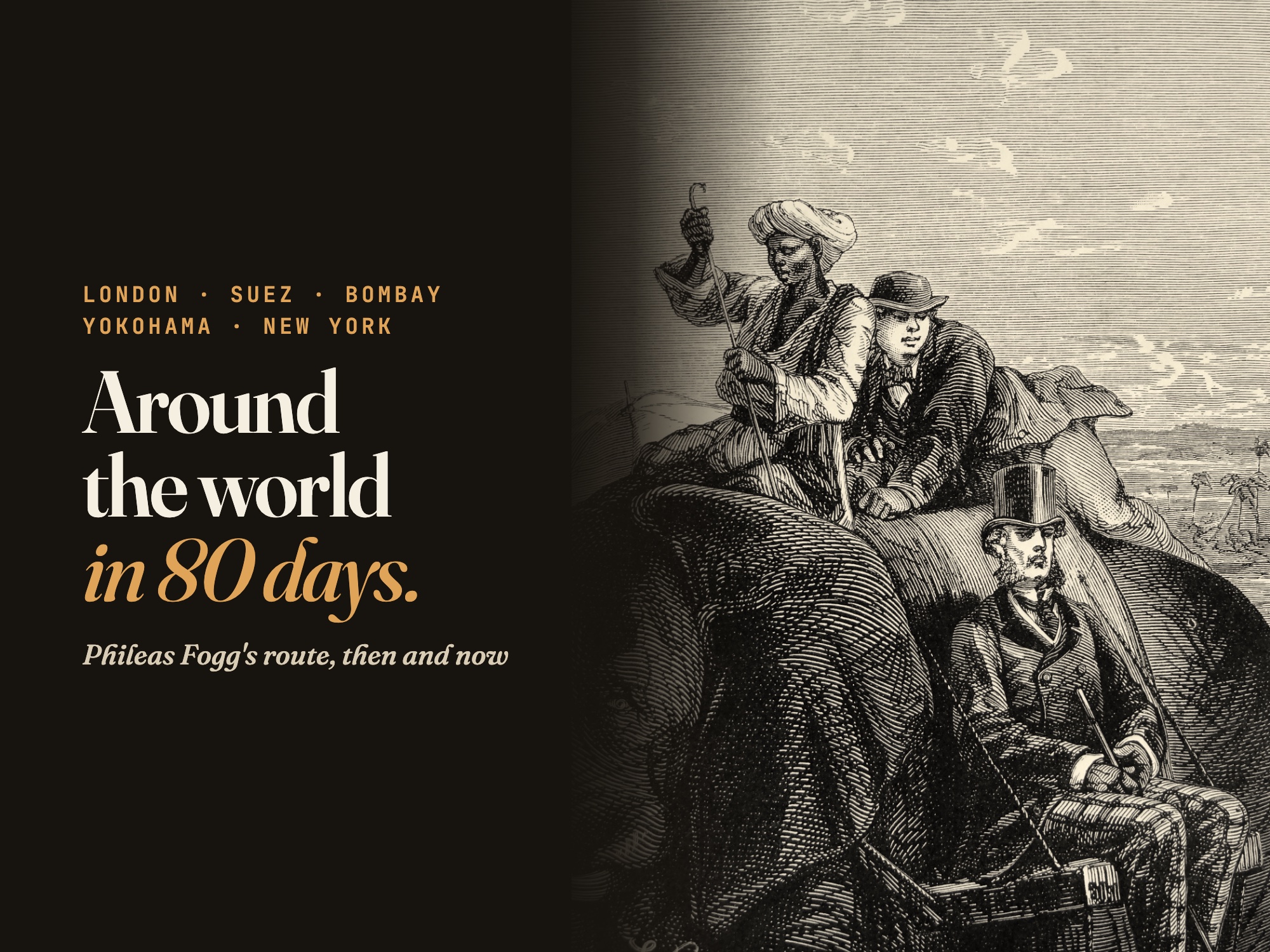
- A railway across India (1870). When the line from Allahabad met the Bombay line at Jabalpur, you could go from Bombay to Calcutta by train. Verne leaves a gap in it on purpose: 50 miles of track that aren't there, so his hero needs an elephant.
Add the Mont Cenis rail tunnel under the Alps, which opened in 1871, and the world had just become small enough to go round in less than three months. The book came out in 1872 as a newspaper serial and in 1873 as a book, and it was an instant hit.
Fogg's route on the map
How to read the map. Red lines are railways and blue dashed lines are steamers. The orange dashed lines are Fogg's improvisations: the elephant, the pilot boat Tankadere, the wind sledge across Nebraska and the Henrietta. Tap any line for its dates and what happened on it. Green lines are TrailX routes near the stops. We drew rail legs over today's roads in the same corridors, and sea legs through the ports and straits the book names, so read them as pictures of the route, not surveyed lines. Kholby, where the elephant ride starts, is made up: we placed it about 80 km short of Allahabad, where Verne's gap would be.
The route, then and now
London to Suez
Then. Fogg crossed the Channel, reached Paris the next morning, and took the train over the Alps by the new Mont Cenis line. He was in Turin at 6.35 a.m. on 4 October and in Brindisi on the 5th. There he boarded the P&O steamer Mongolia, which carried the Indian mails. At Suez, on 9 October, Detective Fix was waiting for him, sure that Fogg was a bank robber on the run.
Now. Eurostar to Paris, then the TGV or Frecciarossa to Turin. Those trains still use Fogg's tunnel under the Fréjus (Mont Cenis) pass, and they've been running again since April 2025, after a landslide closed the line for 19 months. Turin to Brindisi takes about ten hours by train down the Adriatic coast. There is no passenger ship from Italy to Egypt any more, so this is the first leg where you'll need to fly.
On TrailX: Giro dei Pellegrini, Val di Susa (71.9 km, cycling), a loop in the Val di Susa, the valley the Mont Cenis line follows down to Turin. More in Italy.
Suez to Bombay
Then. Thirteen days through the Red Sea, with a stop at Aden to take on coal. Fogg played whist the whole way. Passepartout went sightseeing, and Fix made friends with him. The Mongolia reached Bombay on 20 October, two days early.
Now. Passenger ships no longer sail this route, and since attacks on Red Sea shipping began in late 2023, many cargo lines have avoided it too. Michael Palin, who did the journey without flying in 1988, crossed from Dubai to Bombay on a wooden dhow. Today you would fly.
On TrailX: Matheran Trek from Jumma Patti (9.6 km), a hike up to the hill station above the plains east of Mumbai.
Bombay to Calcutta
Then. The Great Indian Peninsula Railway climbed the Western Ghats. Verne names Kandallah (Khandala), and Sir Francis Cromarty explains that passengers once had to cross the hills by palanquin or pony. The line then ran past Nassik and across the Khandeish to Burhampoor. At Kholby the line simply stopped: 50 miles of track were still missing before Allahabad. Fogg bought an elephant for £2,000. On the way, they rescued a young widow, Aouda, from a sati, and the rescue cost them the two days they had gained. From Allahabad the train went on through Benares to Calcutta. There Fix had Fogg and Passepartout arrested over a temple incident in Bombay. Fogg paid bail and sailed at noon on 25 October, exactly on schedule.
Now. This is the easiest leg to do Fogg's way. The Howrah–Mumbai Mail (12321/12322) still follows much of his line, through Kalyan, Nashik, Bhusaval, Itarsi, Jabalpur and Prayagraj (the old Allahabad). The whole run is about 2,160 km in roughly 37 hours. Better still, break it at Jabalpur and Prayagraj, and take a separate train to Varanasi (Benares). Book Indian trains early: the good classes sell out weeks ahead.
On TrailX: Rajmachi Off-Road Trail (70.2 km, off-road) climbs to Rajmachi fort above the Bhor Ghat at Khandala, the pass Verne mentions; Jabalpur to Bhedaghat Ride (18.8 km, cycling) runs from the railway junction town to the marble gorge of the Narmada; and Dwarka - Prayagraj Sangam (661.7 km) ends at the confluence where Fogg rejoined the railway. More in India. Our Kolkata to London by road guide starts where this leg ends.
Calcutta to Hong Kong
Then. Thirteen days on the steamer Rangoon, down the Bay of Bengal, through the Strait of Malacca and round Singapore. A storm made them a day late into Hong Kong, and the Carnatic for Yokohama seemed to have gone. In fact she was still in port for boiler repairs. When the repairs finished early, she was set to sail that evening instead of the next morning. Fix got Passepartout drunk in an opium den so he couldn't warn his master. Passepartout sailed alone, and Fogg missed the ship.
Now. Fly. Kolkata to Singapore and on to Hong Kong are short flights. A few cruise lines sail between India and Singapore, but not on a regular schedule.
On TrailX: Bukit Timah Hill Loop (9.8 km), through the rainforest on Singapore's highest hill, and New Territories Hike (15.4 km), a hike in Hong Kong's hilly New Territories. More in Singapore.
Hong Kong to Yokohama
Then. With no steamer to take, Fogg chartered the Tankadere, a 20-ton pilot boat, and sailed 800 miles through a gale to Shanghai. In sight of the port he fired a signal and stopped the Yokohama steamer just as she was leaving. In Yokohama he found Passepartout working as a performer in a Japanese circus troupe.
Now. You can get to Shanghai by land, which Fogg couldn't do: the daytime high-speed train from Hong Kong West Kowloon to Shanghai Hongqiao takes a little over eight hours, and there's an overnight sleeper. From Shanghai, fly to Tokyo, about three hours. Yokohama is half an hour by train from central Tokyo.
On TrailX: Yokohama Shikinomori Park Walk (9.5 km), through the wooded parks of Yokohama's Midori ward. And if you're there in season, the Mount Fuji Yoshida Trail Hike (27.3 km) to the summit of Mount Fuji. The 2026 season on the Yoshida Trail runs from 1 July to 10 September, with a ¥4,000 fee and online booking. Outside that window, which includes Fogg's November, climbing is strongly discouraged, so enjoy the view from the Fuji Five Lakes instead. More in Japan.
Yokohama to San Francisco
Then. Twenty-two days across the Pacific on the General Grant. On 23 November the ship crossed the 180th meridian. Fogg didn't notice, but he had just gained a day.
Now. About ten hours by plane. Without flying, you'd need a cargo ship that takes passengers, or a cruise ship moving between seasons in spring or autumn. Both are irregular and take weeks to plan.
San Francisco to New York
Then. The most eventful week of the trip. Fogg arrived in San Francisco on 3 December and got caught up in a fight at a political rally. His train crossed the Sierra Nevada and stopped for two hours at Ogden, enough for a visit to Salt Lake City. It waited three hours for a herd of buffalo to cross the line, and raced across a shaky bridge at Medicine Bow, which collapsed into the river behind it. Then came a Sioux attack near Fort Kearney. Passepartout was carried off and Fogg went after him with soldiers from the fort. By then the train had left, so they crossed the frozen Nebraska prairie to Omaha in a sledge with sails, then took trains via Chicago to New York. They got there on 11 December, 45 minutes after the Liverpool steamer China had sailed.
Now. Amtrak's California Zephyr runs from Emeryville (across the bay from San Francisco) over the Sierra Nevada to Salt Lake City and Omaha and on to Chicago. That's 3,924 km in about 52 hours. East of Salt Lake City it goes through the Colorado Rockies rather than Wyoming, so you won't see Medicine Bow. The Lake Shore Limited takes about 20 hours more from Chicago to New York. Getting off for a night or two at Salt Lake City and Omaha makes it a far better trip.
On TrailX: Golden Gate Park Ride (14.2 km, cycling); San Francisco to Lake Tahoe (445.4 km, on-road), the drive over the Sierra Nevada that Fogg's train climbed; Salt Lake City Walk (7.8 km); Bellevue to Omaha Riverfront Ride (45.6 km, cycling), along the Missouri where the sledge ride ended; and Lincoln Highway US 30 Indiana Drive (108.0 km), part of America's first coast-to-coast road, east of Chicago. More in the United States.
New York to London
Then. Fogg hired the Henrietta, a small steamer bound for Bordeaux. Once at sea, he bribed the crew and had the captain locked up so they would sail for Liverpool. When the coal ran out, he bought the ship from her furious captain and burned her cabins, masts and decks to keep the boilers going. They reached Queenstown (Cobh) in Ireland in the small hours of 21 December and took the mail train to Dublin and the steamer to Liverpool. Fix arrested Fogg the moment he stepped ashore at 11.40 a.m. A few hours later the real thief was found to have been arrested days before, in Edinburgh. Fogg took a special train to London and arrived at 8.50 p.m., five minutes too late, or so he believed.
The twist. By travelling east, Fogg had set his watch forward an hour for every 15 degrees of longitude, and had seen 80 sunrises in only 79 days. It was Friday the 20th, not Saturday the 21st. Passepartout found this out the next evening, when he went to book a wedding for Fogg and Aouda. Fogg reached the Reform Club just as the clock struck 8.45 and won the bet. (Verne's critics point out that a man as exact as Fogg should have known about the date line. There was no official International Date Line until 1884, though in practice ships already changed the date mid-Pacific.)
Now. Cunard's Queen Mary 2 still sails New York to Southampton in seven nights, the last scheduled transatlantic liner service, with one-way fares in 2026 from about US$1,000. If you'd rather follow Fogg via Ireland, fly to Cork or Dublin, then take a ferry across the Irish Sea and the train to London.
On TrailX: Cork Gravel Ride (22.6 km, cycling), near Cobh; the Irish whiskey trail (246.7 km, on-road), which starts in Dublin; and Folkestone to Willesden Green via M20 (142.7 km), the road from the Channel into London where the tour began. More in Ireland and the United Kingdom.
Who has done it for real
- George Francis Train (1870). An American businessman who went round the world in 80 days in 1870, two years before the book. He later claimed Verne had "stolen his thunder".
- Nellie Bly (1889–90). A reporter for the New York World, she went round in 72 days, travelling alone and calling on Verne in Amiens on the way. Her book, Around the World in Seventy-Two Days, was a bestseller.
- Elizabeth Bisland (1889–90). Sent by Cosmopolitan the other way round to race Bly, she finished in 76½ days.
- Michael Palin (1988). Following Fogg's route for BBC television, without flying, he made it in 79 days and 7 hours, with the help of cargo ships, a dhow from Dubai to Bombay and a lot of luck.
An 80-day world tour for 2026
To follow Fogg now, you don't need to rush. Flights cover the legs where ships no longer run, and the time you save is time on the ground. Here's an eastbound plan with a stop at every one of his ports, rail where he went by rail, and a TrailX route at most stops. It leaves eight days spare, because Fogg needed every one he had.
| Days | Where | Getting there | On TrailX |
|---|---|---|---|
| 1–3 | London to Paris and Turin | Eurostar, then the TGV over the Mont Cenis line | Giro dei Pellegrini, Val di Susa |
| 4–5 | Turin to Brindisi | Train down the Adriatic coast | – |
| 6–8 | Suez Canal | Fly to Cairo; the canal at Ismailia and Suez | – |
| 9–13 | Mumbai and the Western Ghats | Fly | Matheran Trek from Jumma Patti, Rajmachi Off-Road Trail |
| 14–18 | Across India to Kolkata | Train, with nights in Jabalpur, Prayagraj and Varanasi | Jabalpur to Bhedaghat Ride, Dwarka - Prayagraj Sangam |
| 19–20 | Kolkata | – | – |
| 21–24 | Singapore | Fly | Bukit Timah Hill Loop |
| 25–29 | Hong Kong | Fly | New Territories Hike |
| 30–32 | Shanghai | High-speed train, about 8 hours | – |
| 33–42 | Yokohama, Tokyo and Fuji | Fly to Tokyo | Yokohama Shikinomori Park Walk, Mount Fuji Yoshida Trail Hike (in season) |
| 43 | Across the Pacific | Fly to San Francisco (you land before you took off) | – |
| 44–48 | San Francisco and the Sierra Nevada | – | Golden Gate Park Ride, San Francisco to Lake Tahoe |
| 49–54 | Salt Lake City and Omaha | California Zephyr, with stopovers | Salt Lake City Walk, Bellevue to Omaha Riverfront Ride |
| 55–57 | Chicago | California Zephyr | Lincoln Highway US 30 Indiana Drive |
| 58–61 | New York | Lake Shore Limited | – |
| 62–69 | Ireland: Cork, Cobh and Dublin | Fly to Cork | Cork Gravel Ride, Irish whiskey trail |
| 70–72 | Liverpool and London | Ferry across the Irish Sea, then train | Folkestone to Willesden Green via M20 |
| 73–80 | Spare | For delays, strikes, and an elephant if you need one | – |
Planning notes
- When to go. Fogg left in October. That's a good month for Europe and India (after the monsoon), and November is pleasant in Hong Kong and Japan. But December on the Zephyr can bring snow in the Sierra and the Rockies, and Mount Fuji is closed to climbers. To climb Fuji, leave at the start of June, which puts you in Japan in early July, and accept the monsoon in India.
- Visas. Most passports need visas or e-visas for Egypt and India, an ESTA or visa for the United States, and possibly one for China; check China's visa-free transit rules. Apply before you leave: you won't have time on the road.
- Without flying. It can still be done, but not in 80 days and not on a schedule. You'd need cargo ships across the Indian Ocean and the Pacific, and a long wait for each sailing.
- Plan each stop. Use our hiking route planner for the walks and the multi-stop road trip planner for the drives.
Eighty days, then and now
In 1872, 80 days was the fastest anyone could go round the world. Today you could fly round it in under three days. That leaves Fogg's 80 days for what he never bothered with: getting off the train. He saw almost nothing on his way round and won his bet anyway. If you follow him, plan to see what he missed.
Written by
fakir27
TrailX scout with more than 90 mapped routes, from the Trans Uttarakhand Shiva Trail to the roads to Kailash and Lipulekh.
Responses